Showing posts with label Berners-Lee. Show all posts

Sunday, February 11, 2018

Fact Computing, Part 2


In a previous post I said that Pelagios Commons/Peripleo does not have its roots in the world of scholarship but in the world of computer science - specifically the ideas of Tim Berners-Lee.(1)  Now let's concentrate more specifically on what Pelagios Commons/Peripleo really does.

The first thing that must be clearly understood is that Pelagios Commons/Peripleo creates no scholarly content and has nothing whatsoever to do with any Classical scholarship.  It is strictly a computer science construct and, with a different database, would be perfectly at home in the world of migration tracking, chemical research, or anything else.

Peripleo is simply a front-end site or data aggregator of a very common type.

Pelagios Commons links large amounts of data produced by other non-related sites and entities and subsumes them under a common format.  It then exploits this umbrella format in order to write its own front-end viewing tools (Peripleo).

Its business model is exactly like that of Huffington Post and any one of hundreds of similar sites.  Through an agreement with providers it reproduces their work tout court.  They say that these unpaid contributors are members of a ‘Community’ but this ‘Community’ is nothing more than the stable of content providers who give away to Pelagios the fruits of their labors.  The most amusing statement on the Pelagios website strenuously denies this plainly obvious fact:


Well,

Pelagios provides no original scholarly content.

Pelagios exclusively displays content provided by others.

Pelagios forces their providers to reduce their own work into a Pelagios format in order for Pelagios' software to display it.

Peripleo implements numerous search options.


What else can Pelagios/Peripleo be but an aggregator/search portal?  In fact, if you go to their Peripleo splash page they clearly say 'Peripleo is a search engine ...'.  The fact that their content providers cooperate in the theft of their own labors does not change the essential nature of the arrangement (This was true for Huffington Post which disguised its essential nature until the moment it went public).  The content providers are said by Pelagios to be members of a ‘Community’.  From my many years as a professional computer scientist I can assure my readers that this type of dishonest rebranding is quite common everywhere in the online world.  The first step in any internet grift is to give it a name that expresses the opposite of what it really is.

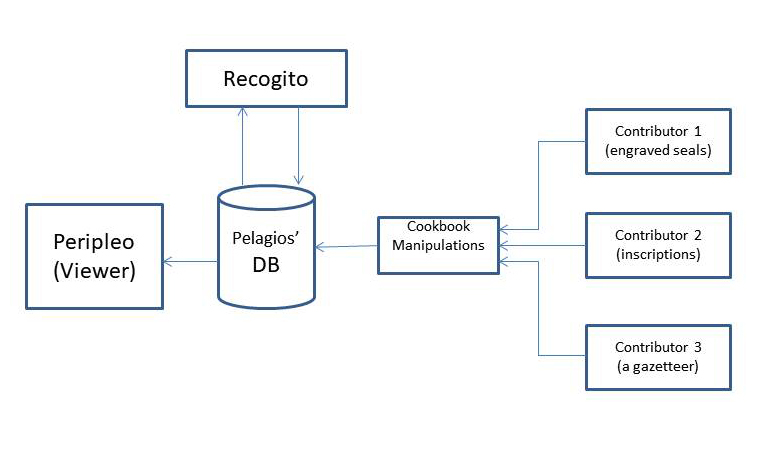
That it is the contributors who are to do all the work is also obvious from the tools that Pelagios Commons provides:

Recogito   This is an ‘online platform for collaborative document annotation’.  But it is not the staff of Pelagios Commons that’s going to do this annotation (how could they?).  It is the contributor, the member of the ‘Community’ who creates this content.

Their Cookbook  makes it easy to see who it is who does all the work for Pelagios (hint: not the Pelagios staff themselves).  In every case the contributors are responsible for massaging all their data into a form that Pelagios can accept.   This is a cost to the contributor of many hours of uncompensated labor.  Pelagios should disguise this aspect better than they do.

The following picture should make these several relationships clearer.


I have claimed that the Pelagios Commons enterprise creates no content.  Strictly speaking that is not quite true.  In fact, Pelagios Commons has achieved the Holy Grail of academia: it is a perpetual motion machine for producing conference papers and web presentations.  If you inspect the list to which I’ve linked you will quickly see who it is who specifically benefits from the Pelagios Commons enterprise.

~~~~~~~~~~~~~~~~~~~~~~~~~

Casting doubt on the Pelagios enterprise is not to deny that some sort of digital structuring of the data that we have from Mediterranean societies of antiquity would be useful.  It would be useful.  But how is that goal to be attained?

The data that comes to us (or generated by us) relative to antiquity is of the most heterogeneous forms.  Locations, building plans, daily customs, food stuffs and their hypothesized yields, customs, clothing, trade, etc.  Everything of human interest falls within the purview of scholars of antiquity.  This is a classic data fusion problem.  Data fusion problems arise in environments where a number of sensors of different types provide data of interest that is to be presented in a uniform view.  Such problems arise in the cockpits of fighter pilots and in very many environmental studies where, again, different sensors (or the same types of sensors with different capabilities) are used to gather data which is then to be united, combined or fused into a single point of view.

Pelagios Commons dimly recognizes that this is the real problem.  But they have performed this task backwards.  They start from the assumption that Linked Data is the solution to everything.  Upon that ideology  they built a product which is useful for no one.  That’s the essential problem.  The site really isn’t good for anything because it started ideologically.   It did not start by asking what it is that scholars of ancient societies really need in the form of digital support.

How should the social data from ancient Mediterranean societies be fused?  But, before that, what does it mean, from the digital point of view, to support such scholars?  Particularly in view of the fact that the scholars in such fields have radically differing interests.


Notes

1) Pelagios Commons here links directly to a discussion of Tim Berners-Lee idea of Linked Data here.


Friday, February 9, 2018

Fact Computing


‘In this life, we want nothing but Facts, sir; nothing but Facts!’
Mr. Gradgrind in Hard Times
Dickens


Recently a friend suggested to me that Helladic.info was a natural candidate for Pelagios Commons.


Sites of classical learning being assimilated
 into Pelagios Commons/Peripleo

‘Absolutely not’, I replied.

And then found myself tongue-tied because I couldn’t adequately express why not.  So that’s what this blog post is about. 

Pelagios Commons is an effort to bring together a large number of websites (themselves all concerned with various aspects of Classical learning) under a single umbrella and, in some sense, merge them into a common resource.  Pelagios is, in computer parlance, a 'front end' or 'concentrator'.  They perform no original scholarship; they take the results and research of various other sites, smash them into homogeneous factlets, and then spew them out again through their results engine which is called Peripleo.

Since they contribute nothing to scholarship itself, what is it that Pelagios Commons is really trying to accomplish?  They are trying to demonstrate that Classical Studies, in all its forms, is suitable for, and can be represented by, something called 'Open Linked Data'.
What is ‘Open Linked Data’?
Wikipedia defines ‘Linked Data’ as:
 ‘In computing, linked data ... is a method of publishing structured data so that it can be interlinked and become more useful through semantic queries.’[2]
(emphasis is mine)

(‘Open Data’ is merely linked data which has no copyright or other usage restrictions.)
‘Open Linked Data’ might be visualized as an enormous network of little fact nuggets.  The ‘interlinking’ mechanism is, of course, the internet but the underlying goal is given in the definition – it is to facilitate ‘Semantic Queries’ and to make the entire congeries of facts ‘more useful’.
It’s the ‘Semantic Queries’ part which gives it away – Open Linked Data is, conceptually, part of the Semantic Web of Tim Berners-Lee.  Now I’m opposed to the idea of any scholar's wasting their time on Semantic Web efforts and have blogged about it here.  I strongly urge my readers to go back and read that entire post but I reproduce the conclusion here:
“And no automation can replace scholarship.  By scholarship I mean the several activities of gathering evidence, organizing, patient collation, reflection, judgment and the expression of these activities in the form of essays, books, diagrams and, yes, even in the form of web sites or blogs.  There is no grand slam against reality; no Tower to the Heavens that we can build that will let us storm the citadel of knowledge.   We have to patiently scrape away at the matrix of the Unknown with our small intellects in order to see it more plainly.”

I oppose the Semantic Web because it is a totalizing (and trivializing) view of knowledge that is inappropriate for fields in the Social Sciences such as Classical Studies.
For example, as the proprietor of Helladic.info I take my field to be the locations of Bronze Age sites.  So far, there are about 2400 such sites in my database and it seems as though site locations would be prima facie appropriate for an Open Linked Data approach.  But it turns out that there is ambiguity about nearly every one of those sites and many of them - as they stand in the DB right now - are likely to be wrong.  My database is not a database of sites so much as it is a database of scholarly arguments about the location and meanings of Bronze Age sites.  In other words, a database of ambiguities, many of which can never be resolved.   And if this is true of relatively straight-forward things like lat/lon pairs how much more true must it be of other Social Science topics in Classical Studies?  Where will we find the semantic web approach to Slavery in ancient Greece and Rome?  Where will we find the Open Linked Data representation of the efflorescence in Fifth-century Athens?  Where will we find the automated web-linked explanation of the collapse at the end of LH III?  Oh, but I forget.  There are available simple fact-based answers, suitable for the Semantic Web, on all these topics.  For example:
Slavery was a bad but necessary thing for Greece and Rome in an age with no petroleum, electricity, or engines.  Classical Athens experienced an efflorescence in the Fifth-century because of the indomitable Will of its people and their love of Freedom.  Mycenaean civilization collapsed at the end of LH III because some Invaders from the Sea destroyed everything.
But I exalt myself onto a plane where I do not belong.  Tolstoy was here long before me.  The famous chapter 1 in Epilogue 2 of War and Peace is perfectly ready for semantic net representation. [2]
Open Linked Data is a trivializing approach to knowledge.
Ready for your close-up, Mr. Gradgrind?
Notes
[1] It's pointless to footnote Wikipedia but the above quote was taken from the article 'Linked Data' on February 9, 2018.
[2] "Louis XIV was a very proud and self-confident man; he had such and such mistresses and such and such ministers and he ruled France badly. His descendants were weak men and they too ruled France badly. And they had such and such favorites and such and such mistresses. Moreover, certain men wrote some books at that time. At the end of the eighteenth century there were a couple of dozen men in Paris who began to talk about all men being free and equal. This caused people all over France to begin to slash at and drown one another. ..."

Blog Posts Concerning the Isthmian Wall

Since 2023 a number of posts concerning the Isthmian Wall and how we located its remaining segments, have appeared on this blog.  This post ...