Sunday, June 4, 2023

Kites, Dragons, and other Traps2

Ancient myths and stories lead us to think that hunting among the Greeks was a solitary activity.   for example Actaeon is accompanied only by his hounds during his famous encounter with the godhead.   Herakles overcame the Cerynaean Hind and the Erymanthian Boar without the help of beaters and Odysseus is alone when he encounters the stag on Circe's island.    A gold ring from shaft grave IV at Mycenae depicts an archer pursuing deer (Cervus elaphus?) from a chariot.   He is accompanied only by his charioteer.


Of course the old stories, paintings, seals or metalwork are not textbooks of hunting;   These fabulous narratives prioritize the moment of encounter and the courage, the determination, or the blind defiance of the protagonists.[1]

Despite the stories, in the Greek world it would have been much more common to hunt in groups.   Certain types of game, boar (Sus scrofa) for example or aurochs (Bos primigenius), are so dangerous that even the myths don't contradict the common wisdom that it would be mad for them to be pursued  by individuals.  The Calydonian boar, for example, can only be subdued by a group which consisted of Meleager and his uncles.[2]  Odysseus is with a hunting party when he is wounded by a wild boar in Odyssey xix.

Hunting in groups would also have been common in the Bronze Age.  The Mycenaeans would not have supposed that the princes of that ancient town customarily traversed the countryside in lonely chariots hoping to encounter a deer.   

The taking of deer (or other ungulates) was such an important activity for the community that it always involved a large group.  The actual shooting of deer would be just the middle stage of a large and elaborate production.  Crucial preparations were carried out before the killing and a long series of necessary activities after it.  Supplying the community with meat involved large numbers of beaters, dogs, nets, and a number of spearmen and/or archers, along with all the necessary machinery for butchering, preserving, caching, and distributing the bag.[3]    One can compare this assemblage to that of Bathurst Inlet in Canada where we find not only killing site(s) but evidence of all the other activities to which I alluded above; an entire landscape devoted to the taking and processing of game.[4a]

For the prehistoric period we have few direct glimpses of communal hunting.  There is some suggestive evidence from the cave at Klissoura that deer could be trapped in the narrow valley and slaughtered. [4]  The ring I mentioned suggests that at least some deer were taken by archers (the other alternative is lances).  One of the gold cups from Vapheio depicts a group of hunters pursuing the Aurochs (Bos primigenius) 
 
Upper panel shows Aurochs being pursued with nets.


This depiction confirms several things.  Groups were involved in a hunt.   The presence of nets shows us that hunting relied on techniques (this could include hedges and woven panels) which funneled the game into a small space where killing and/or capturing was simplified.

In the ancient world hunting techniques were structured so that game was not just encountered by chance.  As I mentioned above game-killing was a semi-industrial activity involving large groups of beaters driving game down fixed routes and into the arms of the killers and the processors.  

How were these fixed routes determined and how did the ambushers know where to wait?  Since at least the Paleolithic communities have laid out boundaries in long lines to guide animals.[4b]  These boundaries could consist of stone walls, lines of cairns, nets, hedges, or combinations of berm and ditch.    These 'game lines' or 'kites' are found all over the world and suggest that groups of humans driving (usually migrating) game into killing traps has been the norm for the last ten thousand years.  These kites, particularly common in the lands around the Levant, derive their name from the period after World War I when pilots  were flying the mails from Cairo to Damascus and Babylon.  Looking down they noticed many stone structures, of unknown purpose, laid out in long lines.  The various shapes of the resulting figures suggested 'kites' or 'desert dragons'.  

  Here's an example of such a kite in Jordan seen from an altitude of ~660 m.  The guide lines ('the funnel') are shown truncated at the upper and lower left.  The corral structure is about 100 m. from E to W and the funnel line that leads to it (the upper left) is about 700 m long.  The circles at the vertices are probably shooting positions.  They average about 2.5 - 3 m in diameter.  The intended game here is antelope.

Desert kite in Lebanon
at 32.177468° N,  37.224406° E


The game drive technique is easy to implement.   Communal groups lay out long lines of stones or cairns along the route which they wish the game to take.   Where they begin these lines or 'rays' are wide apart but are made to gradually converge to form a V-shaped funnel.  The game are driven into the open end of this funnel.   Groups of men and boys (usually at some small distance) wave their arms and make noises such that the game gradually end up in a corral (or are made to walk past shooting positions which are often merely pits or circles of stones).    There are variations, of course.  The end position is often hidden by a break in the slope so that the creatures cannot see where they are going until it is too late.  The end position may place the game against a body of water into which they might be forced.  Sometimes the end position may be a dead fall - such the situation among the Blackfoot Indians already mentioned.

An organization called 'Globalkites' makes available an online database of such kites.  This database records more than 6000 such structures across much of the old world. [5]  Because they do not yet include kites for Nubia, Tibet, Europe or the Americas their count of game-drive systems is probably half the real number.[6]

A coverage map by the Globalkites group.  The
areas where kites are recorded include West Africa, Saudi Arabia,
Lebanon, Syria, Kazakhstan, and Uzbekistan. 


A variant of such a 'game drive system' is also used for hunting caribou and reindeer.  Game-taking on the open tundra in this manner has been practiced since the Paleolithic.  

 John Olsen documents the hunting of raindeer in southern Norway (Lake Vangavatnet) [8] by the use of an impound system [A] that he terms a 'funnel-trap' 


Olsen's caption:
"The system at Slådalen in Reinheimen area was almost three kilometres long and consisted of upright poles. Here, the animals were herded into an enclosure before being moved in groups to the killing ground (ill. by Norwegian Institute for Nature Research)."

This is a good example of a game drive system on [9]   The trap is nothing but a series of upright poles into which the reindeer are driven.  Once they're funneled into the corral they can be sorted for domestication or killing.  

What is genuinely counter-intuitive about this method of hunting is that these stone lines (even when they are continuous) are rarely very high; in all cases the game can easily step over them but do not do so.[7] 

Scotland provides examples of a rather different type of game drive systems.  The Reverend Donald Maclean (1796) gives an account of such a system on the island of Rum in the inner Hebrides: "Before the use of fire arms, their method of killing deer was as follows: On each side of a glen, formed by two mountains, stone dykes were begun pretty high in the mountains, and carried to the lower part of the valley, always drawing nearer, till within 3 or 4 feet of each other.  From this narrow pass, a circular space was enclosed by a stone wall, of a height sufficient to confine the deer ; to this place they were pursued and destroyed. The vestige of one of these enclosures is still to be seen in Rum." [10]

It appears that game drive systems in Scotland did not always consist of walls.   Dean Monro tells us that sometimes it was only necessary to drive game between two bodies of water.  On the island of Jura in the Inner Hebrides the Dean tells us that

"… there are two salt water lochs meeting each other through the middle of the island to within half a mile. And all the deer of the west part of the forest will be brought by an encircling movement to that narrow entry, and the next day brought west again by the same movement, through the same narrow place, and an infinite number of deer will be slain there." [B] 

The area of Jura under discussion.  The red circle is centered on Tarbert Bay
and extends to Tarbert Loch on the W.  Today this is a distance of 0.77 miles.
The possible route onto which the deer were forced may be at the red arrow
. 


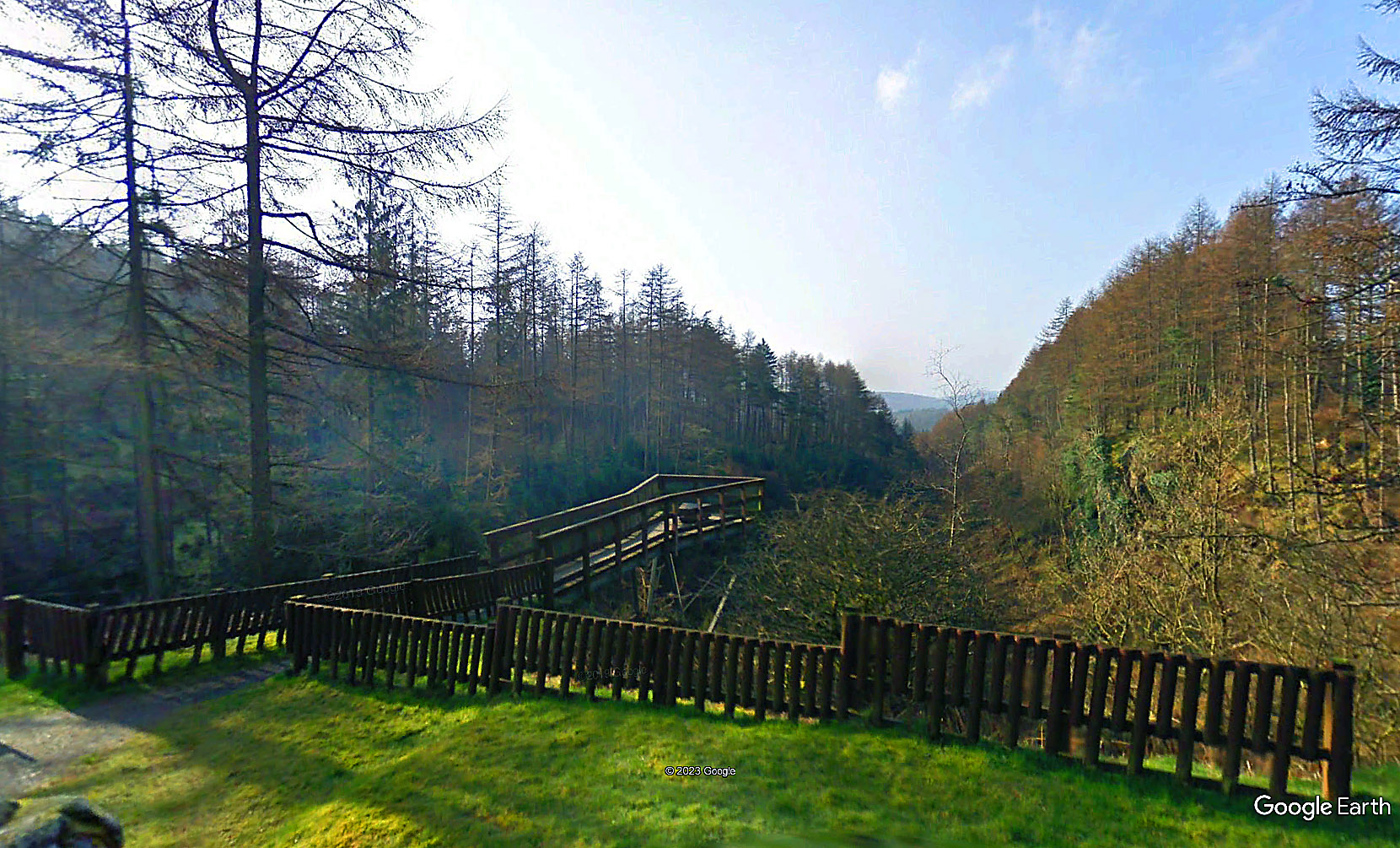
Narrow valleys or glens would suffice for the channeling of deer.

Glen of the Bar (55.007110° N, 4.380103° W) is a narrow valley reputed as a place for trapping deer.

Glen of the Bar.  Letter 'A' marks the
high point of the valley and the spectator
lookout.


Glen of the Bar from the lookout.
View is to S.


Another drive system installed on 'low ground' is at Loch Ruthven.  "The Strathnairn Elrick is near the east end of Loch Ruthven, on the low ground, where there is a pass or small glen, overlooked by a 'cragan'."[11]  

Watson may be referring to the low ground here:  57.323329° N, 4.247311° W.  The map shows it as 'Elrig'.

The word 'Elrick' or 'Elrig' features often as a place name in Scotland.  The word means 'Deer Trap'. [12]

Summary

Hunting in antiquity was often carried out by large groups.  Sometimes, as with boar, the quarry was too dangerous to approach by one person.

But even Hunting of ungulates in antiquity was often carried out by large groups of people taking multiple deer at the same time.

This activity was seasonal.  Does going north with baby deer to feeding grounds after birthing.

What was used were narrow valleys, netted or hedged structures, as well as lines of rocks, cairns or poles which would serve to draw the deer (Red Deer, Fallow Deer, Roe Deer) or other ungulates (antelope, gazelle, reindeer, caribou) into a central killing or capture zone.  These drive structures were usually accompanied by specific hides or ambush sites..

Kill sites Hunting was often not just an activity.  It was a landscape.  That is because many other activities are necessitated by large kills.  Such connected activities would include butchering, skinning and skin preparation, cooking, drying or preserving, and caching.   

Footnotes

[1] Homer's heroes are the preëminent examples.  Idomeneus' courage is compared to the defiance and pugnacity of the wild boar (Sus scrofa) at Il. xiii.  Odysseus is likewise compared to a boar in Il. xvii and, at the conclusion of that same book only the fury of the wild boar is adequate to describe the defiance of 'the two Ajaxes' as they turn to face the pursuing Trojans.   By the time of the Classical and Hellenistic this idea of hunting as a kind of individual determination has been ethicized into the supreme preparation for both warfare and citizenship.  Xenophon's Cynegeticus xviii: "Therefore I charge the young not to despise hunting or any other schooling. For these are the means by which men become good in war and in all things out of which must come excellence in thought and word and deed."  Plato, Protagoras iii.22: "Consequently they (early peoples, rhc) were devoured by wild beasts, since they were in every respect the weaker, and their technical skill, though a sufficient add to their nurture, did not extend to making war on the beasts, for they had not the art of politics, of which the art of war is a part."  Hunting is an important preparation for the 'Guardians' in Plato Rep, viii: " ... not basing his claim to office on ability to speak or anything of that sort but on his exploits in war or preparation for war, and he would be a devotee of gymnastics and hunting."

[2] For Meleager and the Calydonian Boar see this.

[3] Benedict [2005] 430-431 stresses the structures associated with the drive game system in Bathurst Inlet region, in Canada.   Besides drive lines the immediate landscape includes constructed caches (some elaborate), kayak racks, and dwellings.  Among the Blackfoot indians of Montana and southern Alberta  province the primary kill method was of Bison in deadfalls.  Where drive sites did not end in dead falls there were  inevitably corrals.   Such falls and traps generated so much meat that there arose the need for a variety of structures such as for quartering of carcasses,  crushing bone and extracting marrow, boiling and roasting of meat, as well as meat caching (Zedeño et al. [2014] 37).   

[4] In the Klissoura cave in northern Argolid deer were represented in every level from the mid-Paleolithic to the Mesolithic. Stiner et al. [2010] 314.  Klisoura Cave 1 is fronted by a narrow valley and suggests that it was used as an early game-drive system.  As food: Starkovich [2012] 13, " ..., previous studies indicate that the archaeofaunas at Klissoura Cave 1 are dominated by a single species, fallow deer (Dama dama) ... .  The taxon comprises 60-91% of species-specific identifications in the Middle Paleolithic, and 12-78% in the Upper Paleolithic and later layers, though there is variation between assemblages, particularly in later periods ... "  The existence of some 50 clay-covered hearths suggests that meat preparation and cooking may have been done on a large scale.  Karkanas et al. [2004] 522 say that the hearths at Klissoura Cave 1 were associated with bones of fallow deer (Dama dama), hare (Lepus europaeus), rock partridge (Alectoris graeca) and Great Bustard (Otis tarda).

Elsewhere the Red deer (C. elephas) is represented, e.g. in the Franchthi Cave. Douka et al. [2011] 1143.

[4a] Benedict [2005] 432, "At times during the past, the Copper Inuit or their Thule ancestors established substantial settlements near game-drive sites along caribou migration routes. Facilities for drying and storing large quantities of meat were associated."

[4b]  It may be appropriate to mention here the hypothesis that the cursuses of Britain, Scotland, and Ireland are an early form of game drive system.  Fletcher [2011] position 1074 says "I hesitate to suggest that they may ever have served as a means for killing deer ... but similar constructions were later to be used to direct deer."  What seems most compelling to me is that at one of them, Woldgate Cursus terminal at Rudgate in Yorkshire, arrowheads were found.  The specific spot is here: 54.076233° N, 0.320543° W.   Woldgate Cursus is reviewed in McOmish and Tuck [2002] 28 who provide a photograph of the arrowheads.  The Woldgate Cursus is also described at this website and this website.  There are a number of fantastical theories about the construction and use of cursuses.  These theories are reviewed in Maguire [2015]. 

[5] Globalkites is here; their interactive map is here.

[6] Nubia:  Storemyr [2021].  Tibet: Fox and Dorji [2009];  North America: Colorado: Benedict [1975], Benedict [2005]; Brink [2005]; Canada: O'Shea et al  [2013];  Norway: Olsen [2013]; Scotland and England: Watson [1913]; Fletcher [2011].

[7] Benedict [2005] 432 quoting Stefánsson [1921]:  "'It seems absurd,' wrote Stefánsson (1921, p. 402), 'that two stones, one on top of the other, reaching an elevation of only a foot, should be feared as much by the caribou as actual persons but that appears to be the fact.'

[A] An 'impound' system drives the animals into a corral where the priority is to capture and domesticate them.

[8] Olsen [2013] fig. 14. No page numbers in the online edition.  The position is at roughly this location:  61.853444° N, 8.962183° E

[10] Watson [1913] 162.  The island of Rum is here: 56.999030 N, 6.329717° W.

[B} As reported in Watson [1913] 161.  Translation is by Fletcher [2011].  The Kindle position is 1427.

[11] Watson [1913] 164.

[12] For etymology and definition see Watson [1913] 163: "The Elrick was an enclosure, usually in relatively low ground, into which deer were driven by the 'tinchell'."  Tinchell, also tainchell, are beaters.  

Also in Fletcher [2011] : "I wish to mention briefly the Scottish equivalent known in Gaelic as an elrick, or sometimes also referred to as elerc, an Old Irish word in origin which refers to the spot at which driven deer might be ambushed in a narrow defile."  No page numbers in the online edition where the position is given as 1384.

~~~~~~~~~~~~~~~~~~~~~

[2] Feldman and Sauvage [2010] 133.

[3] Evenson [2002]  "A lone hunter from the light background turns and faces to the right, poising to spear a stag who is running left towards him across the wavy zone-change line (cat. no. 16H43). These central opponents are, in de Jong’s reconstruction, the only figures who strike active poses, the other hunters and dogs moving in processional form across the panels."

[4] Halstead [2002]  "The same general observations can be made from this year’s work as were made last year: the material is strikingly more mixed anatomically, taxonomically and taphonomically than the big groups of burnt bone studied in 2000; by far the commonest taxa are pig and sheep; and red deer continue to be the commonest wild animal"


Bibliography


    Achard-Corompt et al. [2013] : ACHARD-COROMPT, Nathalie (ed.) ; RIQUIER, Vincent (ed.). Chasse, culte ou artisanat ? Les fosses « à profil en Y-V-W »: Structures énigmatiques et récurrentes du Néolithique aux âges des Métaux en France et alentour. Dijon: ARTEHIS Éditions, 2013.  Online here. ISBN: 9782915544718.

    Anderson  [1985] : Anderson, J.K.,  Hunting in the Ancient World.  University of California Press, Berkeley, California.  1985.

    Barringer  [2002] : Barringer, Judith. The Hunt in Ancient Greece.  Johns Hopkins University Press. 2002.

    Benedict  [1975] : The Murray Site: A Late  Prehistoric Game Drive System in the Colorado Rocky Mountains.  Plains Anthropologist  (20(69)), 161-174. 1975.  Online here.

    Benedict [2005] : Benedict, James B., 'Tundra Game Drives: an Arctic-Alpine Comparison', Arctic, Antarctic, and Alpine Research (37:4)  425-434.  2005.  Online here.

    Betts and van Pelt [2021] : Betts, Alison, W. Paul van Pelt. The Gazelle’s Dream: Game Drives of the Old and New Worlds. Sydney University Press. 2021.

    Brink  [2005] : Brink, J. W., "Inukshuk: caribou drive lanes on southern Victoria Island, Nunavut, Canada".   Arctic Anthropology , 42(1): 1-28. 2005.  Online here.

   Broneer [1966] : Broneer, Oscar.  "The Cyclopean Wall on the Isthmus of Corinth and Its Bearing on Late Bronze Age Chronology",  Hesperia (35:4), 346-362.  The Journal of the American School of Classical Studies at Athens. 1966.  Online here.

   Broneer [1968] : Broneer, Oscar.  'The Cyclopean Wall on the Isthmus of Corinth, Addendum',  Hesperia  (37:1), 25-35, The American School of Classical Studies at Athens. 1968.  Online here.

   Buchholtz  [1987]: Buchholtz, Curt.   Rocky Mountain National Park: a History   Published by University Press of Colorado, 1987.  ISBN: 9780870811463

Crassard et al. [2023] : Rémy Crassard,Wael Abu-Azizeh, Olivier Barge, Jacques Élie Brochier, Frank Preusser, Hamida Seba, Abd Errahmane Kiouche, Emmanuelle Régagnon, Juan Antonio Sánchez Priego,Thamer Almalki, Mohammad Tarawneh, 'The oldest plans to scale of humanmade mega-structures'. PLOS ONE, May 17, 2023.  Online <a href="https://journals.plos.org/plosone/article?id=10.1371/journal.pone.0277927">here</a>

Douka et al. [2011] : Douka et al. [2011] : K. Douka with C. Perles, H. Valladas, M. Vanhaeren, R.E.M. Hedges,  'Franchthi Cave revisited: the age of the Aurignacian in south-eastern Europe', Antiquity 85 : 1131–1150.  2011.  Online here.

    Enloe  [2003] : Enloe, James G., 'Acquisition and processing of reindeer in the Paris Basin',  Zooarchaeological Insights into Magdalenian Lifeways. pp. 23-31. 2003.  Online here.

    Evenson [2002] : Evenson, Freya. '11. Hunting Scenes in the Frescoes', in Davis, Jack et al., <i>THE PYLOS REGIONAL ARCHAEOLOGICAL PROJECT: 12th Season Preliminary Report to the 7th Ephoreia of Prehistoric and Classical Antiquities, Olympia on the Results of Museum Study August-October 2002</i>.  Online here.

    Feldman and Sauvage [2010] : Feldman, Marian H. and Caroline Sauvage.  'Objects of Prestige? Chariots in the Late Bronze Age Eastern Mediterranean and Near East', <i>Ägypten und Levante / Egypt and the Levant</i> (20), 67-181  Austrian Academy of Sciences Press.  2010.  Online here.

    Fletcher [2011] : Fletcher, John (2011). Gardens of Earthly Delight. The History of Deer Parks. Oxbow Books. 2011.  Kindle Edition.  ASIN ‏ : ‎ B00BWAZBUG

     Fox and Dorji  [2009] : Fox, Joseph L. and Tsechoe Dorji, 'Traditional Hunting of Tibetan Antelope, Its Relation to Antelope Migration, and Its Rapid Transformation in the Western Chang Tang Nature Reserve',  Arctic Antarctic and Alpine Research ,  1-15.  May, 2009.  Online here.

    Gregory  [1993] : Gregory, Timothy E.  Isthmia V; The Hexamilion and the Fortress .  American School of Classical Studies at Athens.  Princeton, N.J.  1993.

    Halstead [2002] : Halstead, Paul. '5. Museum Study of Animal Bones', in Davis, Jack et al., <i>THE PYLOS REGIONAL ARCHAEOLOGICAL PROJECT: 12th Season Preliminary Report to the 7th Ephoreia of Prehistoric and Classical Antiquities, Olympia on the Results of Museum Study August-October 2002</i>.  Online here.

     Karkanas et al. [2004] : P. Karkanas, M. Koumouzelis, J.K. Kozlowski, V. Sitlivy, K. Sobczyk, F. Berna and S. Weiner. 'The earliest evidence for clay hearths: Aurignacian features in Klisoura Cave 1, southern Greece', Antiquity (78), pp. 513–525. 2004. Online here.

     Maguire [2015] : Maguire, Kristyn M., 'Topographical Relationships between Cursus Monuments in the Upper Thames Valley', Thesis submitted for the Master of Science in Applied Landscape Archaeology in the Department for Continuing Education, University of Oxford, United Kingdom, 2015.  Online here.  

McOmish and Tuck [2002] : 'The Woldgate Cursus; Humberside, Survey Report', Archaeological Investigation Series. 2002. Online here.

     Morgan [1999] : Morgan, Catherine.  Isthmia VIII; The Late Bronze Age Settlement and Early Iron Age Sanctuary. The American School of Classical Studies at Athens.  Princeton, New Jersey.  USA.  1999.  ISBN: 0-87661-938-3.

   Olsen [2013] : Olsen, John. 'Hunting using permanent trapping systems in the northern section of the mountains of Southern Norway: focus on wild reindeer',  <i>Chasse, culte ou artisanat ? Les fosses « à profil en Y-V-W »: Structures énigmatiques et récurrentes du Néolithique aux âges des Métaux en France et alentour. Dijon: ARTEHIS Éditions, 2013. Online here.  ISBN: 9782915544718.

   O'Shea et al  [2013] : O'Shea, John and Ashley K. Lemke and Robert G. Reynolds,  'Nobody Knows the way of the Caribou”: Rangifer hunting at 45&deg; North Latitude',  Quaternary International  (297), pp. 36-44. 2013.  Online here.

Prummel et al. [2011] : Prummel, Wietske and Marcel J.L.Th. Niekus 'Late Mesolithic hunting of a small female aurochs in the valley of the River Tjonger (the Netherlands) in the light of Mesolithic aurochs hunting in NW Europe', Journal of Archaeological Science (38:7) 1456-1467. 2011.  Online here.

   Simpson and Hagel [2006] : Simpson, R. Hope and D.K. Hagel.  Mycenaean Fortifications, Highways, Dams and Canals.  Paul Äströms Förlag. Sweden. 2006.  ISBN: 978-917081-212-5.

    Starkovich [2012] : Starkovich, Britt M., 'Fallow Deer (Dama dama) Hunting During the Late Pleistocene at Klissoura Cave 1 (Peloponnese, Greece)', Mitteilungen der Gesellschaft für Urgeschichte (21), 11-36. 2012.  Online here.

    Stiner et al. [2010] : Stiner, Mary C. Janusz K. Kozlowski, Steven L. Kuhn, Panagiotis Karkanas and Margarita Koumouzelis, 'Klissoura Cave 1 and the Upper Paleolithic of Southern Greece in Cultural and Ecological Contexts', Eurasian Prehistory, (7:1) 309–321. 2010.  Online here.

    Storemyr [2021] : Storemyr, Per. 'The ancient game traps at Gharb Aswan and across Lower Nubia (north-east Africa)', pp. 361-398 in A. Betts & W. P. van Pelt (Eds.), <i>The Gazelle’s Dream: Game Drives of the Old and New Worlds</i>, Sydney University Press. 2021.  Online here.

    Watson [1913] : Watson, William J., 'Aoibhinn an Obair an t-Sealg', The Celtic Review (9:34), 156-168. 1913.  Online here.

     Wiseman  [1966] : Wiseman, James R.,  'A Trans-Isthmian Fortification Wall',  Hesperia  (32:3) 248-275. The American School of Classical Studies at Athens, 1963.  Online here.

     Zedeño et al. [2014] : Zedeño, Maria Nieves with Jesse A. M. Ballenger and John R. Murray. 'Landscape Engineering and Organizational Complexity among Late Prehistoric Bison Hunters of the Northwestern Plains', Current Anthropology, (55:1), pp. 23-58 . 2014. Online here


Sunday, May 14, 2023

 I 💗 the French

 
I have to express an un-American thought.
I like the French.
There was a time when I didn’t but, at that time, I only knew Paris and the people of Paris can be, well, tense. There was the high prices thing of course but that was my own fault. If you’re not morally and psychologically prepared to pay 8 euro for a cup of tea then you don’t belong in Paris in the first place. Once I discovered the Paris McDonald’s things ran more smoothly.
The people of France outside Paris are a completely different kettle of fish, if that’s the image I want.   And I was to blame for that regrettable incident in Carpentras when I was yelled at by a French hooker. I had innocently wandered into the local Hall of Justice carrying a large tourist-type camera under the impression that it was a visitor’s information office. There were all these well-dressed young ladies standing around waiting to have their legal affairs tended to and it looked like I was pushing to the head of the line. The confusion was soon straightened out but not before one of them shouted at me: 'Mon vieux! Ce n’est pas le Bureau des Informations Touristiques!!' (‘Hey Pops, this isn’t the Office of Tourist Affairs!’) in what I thought was an unfortunately strident manner. 

Mon vieux, indeed!
Aside from that one incident, though, all the people that we met in France were like people you’d meet anywhere in the Mediterranean. They were understanding, polite, helpful, and very hospitable. We might have been in Spain or Greece.
At first I refused to believe it. I told S. that these nice people weren’t French at all. ‘They just can’t be. It’s well-known’, I said, ‘that the French government imports Romanians during the high season to work with tourists.’
‘Romanians?’  S. said that she hadn’t heard that. 
‘Well, maybe not Romanians. It could have been Lithuanians. The point is that these people that we’ve been encountering are not really French. The government cannot entrust the multi-billion dollar tourist industry to the French people; there would be too many risks.’
‘What sorts of risks?’ she asked tentatively.
‘Think about it. Everyone knows that the French go on vacation for twelve weeks during the summer. What would happen if the hotel you were staying in just suddenly closed so that the proprietor could go running off to St. Tropez with his girlfriend (sa petite amie, copine)?’ And they strike at the drop of a hat. What if you were stuck on top of the Eiffel tower while the lift operators went on strike (se mettre en grève)? You wouldn’t like that, would you?’

‘N..no’, said S., a trifle uncertainly.
‘Well then. And you know how bureaucratic they are. Would you like to have to buy a safe-swimming license (permis de baignade sécuritaire) every time you wanted to use the hotel pool, and with a three-day wait (trois jours d'attente)? No, of course not.  That’s why the government treats the tourist industry like the agriculture industry. They bring in foreign workers.’
‘I think you’re crazy’, said S., ‘these people are as French as Brie and Champagne (Appellation d'Origine Contrôlée)!’

I shook my head sadly at her naiveté and our conversation passed on to other topics.
Later, though, I found out the shocking truth.

Eiffel Tower seen from the Trocadero.  March, 2012.
We were in Vaison-la-Romaine where we had reservations for three nights. ‘I’ll show you that I’m right’, I said to S. I had purchased a Romanian phrase-book in Arles just the day before.
When our hotel door was opened by the landlady I said in my most polite Romanian, ‘Buna! Suntem turiști din America. Avem rezerve. (Hello!  We are tourists from America.  We have reservations.)

‘Bonjour’, she replied slowly with a puzzled air.

‘They have to stay in character’, I whispered to S. ‘They’re sort of like historical re-enactors.’
‘I will get my husband (Je vais chercher mon mari).',  she said in very good re-enactor French.

Soon our host appeared drying his hands on a dish towel and welcoming us to Vaison-la-Romaine. But it appeared that there had been a mixup. They were expecting us the following week. A check of e-mails followed and he said to his wife ‘Ils ont raison (They’re right)’. A flurry of apologies followed. We were assured that we would have the accommodations that we wished but they would be in different rooms from those we had reserved.

‘You have been inconvenienced’, said our host, ‘.. and the reputation of our hotel is paramount; your stay will be on us, free!’
Free? This was a saving of more than 300 euro. I was triumphant. It was a perfect example of the Romanian hospitality that I’d been talking about. I couldn’t resist the opportunity to reach out to this foreign gentleman and let him know how much I appreciated his kindness and generosity.
‘Multumesc! (Thank-you)’, I said, with a broad wink to let him know that I was in on the deception.
‘What?’ said our host.
‘Multumesc,’ which I followed with what I hoped sounded polite, ‘Cum va numiti? (What is your name?)’.

‘I’m sorry, I don’t understand what you’re saying; are you perhaps from .. Romania?’, said the host.
‘No’, said the ever-helpful S. to the host, ‘He thinks that you're all Romanians.’
‘Romanians!? Us!?’ shouted our host. He and his wife laughed for five minutes. Wiping the tears from their eyes they made a shocking confession.
‘Every year we have to go to the immense trouble of spreading the rumor that all the workers in the French tourist industry are Romanians – ‘
‘Lithuanians’, corrected his wife.
‘Lithuanians, Romanians, Pomeranians!  It doesn’t matter. We even have to take out ‘help-wanted’ ads in Romanian in the tourist-trade magazines; all phony of course.’
I was staggered. ‘But..but, why?’ I managed to say.
‘We just can’t let it get out that the French tourist industry is actually staffed and run by the French. If we did that no Americans would ever come to France.’
‘Really’, said his wife, ‘Americans have the most terrible ideas about us. They think that we’re always on strike…’
‘…that we’re too bureaucratic…’, said her husband.
‘…and that we’re unfriendly, lazy and always on vacation!’, she continued.
‘That’s a scandal’, said S. ‘who would think such a thing?’
‘Who indeed?’, I asked innocently.
The host was still chuckling. He said to us, ‘Our new American friends; welcome to our hotel. Can I offer you a small brunch of Brie and Champagne (Appellation d'Origine Contrôlée)?’

~~~~~~~~~~~~~~~~~~~~~~~~~~~

Postscript to The Honorable Emmanuel Macron, President of the Republic of France: 

Just kidding, mon vieux.


Mavrospelaies, C7724

 There's a site in the Corinthia called Mavrospelaies (Black Cave, C7724).  Now, wherever it was (and we're going to talk about that), a single grave was found nearby.  This find was the result of plowing during which the sarcophagus cover was ripped off.  Inside three vases were found: an amphora and two aryballoi. [1]

Let's look at the general area under discussion:


Mavrospilies is not the most important find in the Corinthia but there has been some confusion about its precise location.

Lawrence herself gave the location as in "the field of Michael Roumeliotis near (east of) Mavrospelaies, about a three minute walk above (i.e., south of) the road which leads west from the Roman Villa".  Let's parse this.  The Roman Villa is 'Shear's Villa' which is F7371 and is located at 37.908442° N, 22.864786° E.  There is a road that continues on west from there.  Somewhere on that road we turn S and walk for three minues to M. Roumeliotis' property.  It looks something like this:


Here the yellow line is the road that Lawrence is talking about, anchored on the right (E) by Shear's Villa.  We do not yet know where on the yellow line it is that we're supposed to turn S.


James Wiseman uses Lawrence as a source.  He describes the site as 'not far from Aetopetra' and 'The grave was found in a field belonging to Michalis Roumelites.'[2]


The location of the BA settlement (C915) on the ridge of Aetopetra is firmly established at 37.905633° N, 22.838495° E.  The ridge itself looked like this recently. [3]


As photographed by Blegen a century ago: [4]

From Carl Blegen, 'Corinth in Prehistoric Times', 4, fig. 2.  1920.


I am, once again, going to take the opportunity to condemn the lazy practice of identifying a site with a specific landowner. In this respect some archaeologists are worse than others (looking at you, E. Kanta) but it is to be condemned wherever encountered. Goodness knows that I wish Mr. Roumeliotis long life but 59 years after Lawrence's report the land is very likely to belong to someone else whose identity, at this late date, would be very difficult to discover. More than that Mr. Roumeliotis might very well have owned widely separated plots - a common practice and one which, now, would make the site almost impossible to locate. It is remarkable that prehistorians should be so committed to the ephemeral when they, of all people, are aware of the profound changes associated with the passage of time.

Well, if Mavrospelies is 'near' Aetopetra let's see where Aetopetra is located on a map.  In this first map I have related Aetopetra to the road leading W from Shear's Roman Villa.


In this second map from Google Earth we are looking approximately SW with the ridge of Aetopetra in the foreground.


The Aristeia Project (Mazarakis-Ainian [2015], they reference Lawrence's article) describes the site as being between the North Cemetery (C7280) and the Potter's Quarter (F7661). [5] But Mavrospelaies and Aetopetra are far to the W of these two.  It looks like this:


Here the Potter's Quarter and the North Cemetery are on the right of the map.  Aetopetra Ridge is on the left.  The white line which connects these two areas is about 2.7 km. long.

Morgan  gives us the best orientation by describing the site as 'immediately west of ... Aetopetra'. [6] I have followed her lead by choosing a more or less plausible location just to the west of the ridge of Aetopetra (C915) whose location is firmly established.  It looks like this:


Here we're looking at the western end of the 'orange' road that goes back to Shear's villa on the east.  The purple line extends along a tributary road 3 minutes (260 m) to the S of the orange road.  I have marked 'Mavrospilies' at the S end of the purple mark.  The blue circle is centered on Mavrospilies and is 100 m in radius.  The actual site should be somewhere in that circle.

I'm still somewhat discomfited by the tendency, on the part of some, to place Mavrospilies somewhere back towards ancient Corinth but, given Morgan's  precision, I think that this is the best I can do for the moment.


Footnotes

[1] Lawrence [1964] 89.

[2] Wiseman [1978] 100.  ''Not far from Aetópetra and in the ravine of Mavrospeliés ... ''.

[3] Google Street View.  Heavily post-processed by me for clarity.

[4] Blegen [1920] 4, fig. 2.  Heavily post-processed by me for clarity.

[5] Mazarakis-Ainian [2015]:  'Maurospelaies', here.  Additionally the Aristeia Project says of Mavrospelaies that 'The grave belongs to a group of 5 graves.'  It doesn't.  It is a single grave which Lawrence grouped in with four other widely-separated grave complexes.

[6] Morgan [1999] 470,  '9 Mavrospelies'.

Bibliography

Blegen [1920] : Blegen, Carl W.,  'Corinth in Prehistoric Times', <i>American Journal of Archaeology</i> [24:1] pp. 1-13. 1920.  Online here.

Lawrence [1964]:  Lawrence, Patricia. ‘Five Grave Groups from the Corinthia’, <i>Hesperia</i> (33:2), pp. 89-107, 'Grave at Mavrospelaies', pg. 89. Online here.

Mazarakis-Ainian ed. [2015]:  Mazarakis Ainian, Alexander . Η Κοινωνική Αρχαιολογία του Ελληνικού Κόσμου κατά την Πρώιμη Εποχή του Σιδήρου και την Πρώιμη Αρχαϊκή περίοδο (The Aristeia Project: The Social Archeology of the Greek World during the Early Iron Age and the Early Archaic period), 'Maurospelaies', Online here.

Morgan [1999]:  Morgan, Catherine. Isthmia VIII; The Late Bronze Age Settlement and Early Iron Age Sanctuary. The American School of Classical Studies at Athens. Princeton, New Jersey, 1999.

Wiseman [1978]:  Wiseman, James. The Land of the Ancient Corinthians. Paul Aströms Förlag, Göteborg, Sweden, 1978.


Friday, April 14, 2023

Dr. Kelder and the Null Hypothesis

There's an old joke about historians which says historians start out by looking backwards and they end up by thinking backwards.  

And yet I've never found this to be true.  Most historians carefully lay out the evidence and give a detailed demonstration showing how the data supports some hypothesis. It's true that almost every historical argument is probabilistic in nature (an induction) and, as a result, arguments may be well or poorly supported. Nevertheless, almost all historical reasoning proceeds methodically from data to conclusion.

A case in point is Dr. Jorrit Kelder of Oxford who maintains the position that the people of Mycenaean Greece lived in a single state. I have called this the Unified Mycenaean State (UMS) hypothesis.[1]

Dr. Kelder’s hypothesis has three parts:

A. The Mycenaean civilization was a single and united political unit
B. This political unit was a monarchy
C. The central place in this political unit was Mycenae.

And that’s it.  Three parts, a united monarchy centered in Mycenae.[1]

To support this thesis Kelder has piled up a series of barely related observations hoping, I suppose, that if the pile of facts can be made high enough scholars will ultimately be compelled to accept his conclusion.  But, logically, this method can never succeed.  This argument can never be made more than a probabilistic one (i.e. cannot be made deductive) and the facts as they stand are very far from supporting his conclusion.  Speaking in general, the risk of proceeding in such a way is to expose the advocate to confirmation bias.[2]  In order to avoid this it is necessary to proceed in a very different way. That way, in a nutshell, is to form the logical opposite of the desired hypothesis and do one's best to support this null hypothesis. If the null hypothesis can be shown to be probable then, fine, we can reject the original hypothesis and be on our way. If the null hypothesis cannot be supported and is shown to be less probable or even improbable then that supports the original hypothesis (note: it does not prove the original hypothesis). What happens when we try this with Kelder's thesis? Let's find out.

We have stated Kelder's actual thesis above; how do we form its opposite? Let's start by expressing the three parts (A, B, and C) of his thesis (H0) in logical notation:

H0: A ∧ B ∧ C;             where '∧' indicates logical 'AND'.

It’s easier to negate if we change the AND operators to ORs.  This kind of transformation is done all the time in formal logic, circuit design, etc.  We do it like this:

H0:      ~(~A ∨ ~B ∨ ~C);     where '∨' indicates logical 'OR'.

This is the exact logical equivalent of H0.  Its negation is straight-forward; we simply remove the outer negation sign with its parens.  The result looks like this:

~H0:      ~A ∨ ~B ∨ ~C

... or stating it in words:
~H0:       “The Mycenaean civilization was NOT a single and united political unit OR it was NOT a monarchy OR it was NOT centered at Mycenae”

This is the negation of the original thesis.  If we can make ~H0 fail then that lends support to H0.  But if we cannot reject ~H0 then H0 is not supported and, perhaps, even rendered less tenable. 

Of course, if we look at what we’ve done we notice that some of these clauses are of less worth than the others.  The original hypothesis is really overdetermined.  
The idea that Mycenae was a significant political center of some sort is, actually, overwhelmingly probable given what we know about it.  And we know that the monarchical form was common enough in the BA so that positing a king for our hypothetical state is not improbable.  So that this hypothesis wants to join two ideas which are highly probable to a third idea (that the Mycenaeans lived in one united state) which is highly controversial.  No doubt this is to give the UMS hypothesis logical cover.

It would be a good idea to examine the UMS hypothesis on its own and separate from the other two.  For example, if Mycenaean civilization did NOT form a united state then it hardly matters what the governance of this non-existent state was or where it was headquartered.   If the Mycenaean polities were truly independent of each other then it wouldn’t matter whether they were governed by a Sun King or the United Agricultural Worker’s Council of the Argolid, local 38.    Nor would it matter if this non-existent state was headquartered at Mycenae or in a rowboat in the Saronic.  The gravamen of Kelder’s thesis is that the Mycenaean people were united in a single polity of whatever form and wherever headquartered.

I propose, then, that we can restate Kelder’s thesis as simply:  The Mycenaean people were united in a single state.  H0 now becomes H0’.  And this is just

H0’:      A             ; the Mycenaean  people were united in one state

And the negation is:

~H0’:      ~A            ; the Mycenaean people were NOT united in one state.

Now our approach is to support ~H0’.   If we can do this then H0 is weakened or even rejected.  But if we must reject ~H0' then H0' will be supported and we can go on to discuss style of leadership and location of its headquarters which are really separate questions and for which different types of arguments will be appropriate.

What would it take to support ~H0’?
  1. Well, we could suggest that, among the many Mycenaean projects that we can identify, there is no sign that they were dictated by the concerns of the political center.  In other words we could say that, while there are some similarities (due primarily to karstic geography), there is no unifying vision.
  2. We could point to the natural behavior and tendency of equipotent (or nearly equipotent) states to refuse voluntary unification.
  3. We might point to the likely infeasability of such a project of unification of governance by showing that the landscape involved posed severe geographic obstacles to a program of political/military unification.
  4. We might show that the different divisions of the Mycenaean world were often at war and that great schemes of defence are everywhere visible.
  5. We might demonstrate the difficulty of picking any specific Mycenaean statelet as having a clear resource advantage over the others.  We would be trying to show that the various statelets were equipotent, or nearly so.
  6. We could point out that none of the Mycenaean statelets had any clear technological advantage over the others.
  7. We could say that the historical record suggests that nearly matched states who go to war over unification typically wage those wars over long periods of time, even centuries.  It took Rome more than a century to unite itself to the Samnites.

If we could show that these things were true then we would have taken a big step towards supporting ~H0’ and thus weakening support for Kelder’s original thesis (H0').  If these things were false then we could reject ~H0' and, consequently, support H0'.

Unfortunately, we do not end up supporting H0'.

That is because every last one of these proposed criteria are either true or exceedingly probable.  In other words, under these criteria, we cannot reject ~H0'.

Footnotes
[1] For my extended critique of Kelder's position see this, this, and this.   I do not accept Dr. Kelder's thesis but just to be clear: Kelder is an historian for whom I have a profound respect.  He has done a great service to BA studies by maintaining this position on the dominance of Mycenae and he has argued for it as well as anyone could.  I may have given the impression in my other writings that Kelder originated this position.  That is not the case.  In its modern form this hypothesis is at least a century old and has been argued for by Desborough among others.
[2] I'm sure that Kelder has not done this.  
Confirmation bias is not the tendency to 'cherry-pick' the facts.  It is the psychological tendency to notice those facts which support some conclusion and not to notice facts that do not.  It is a subtle problem because it is almost indistinguishable from ordinary scholarly argumentation.  After all, noticing relevant facts is what we do.

Blog Posts Concerning the Isthmian Wall

Since 2023 a number of posts concerning the Isthmian Wall and how we located its remaining segments, have appeared on this blog.  This post ...